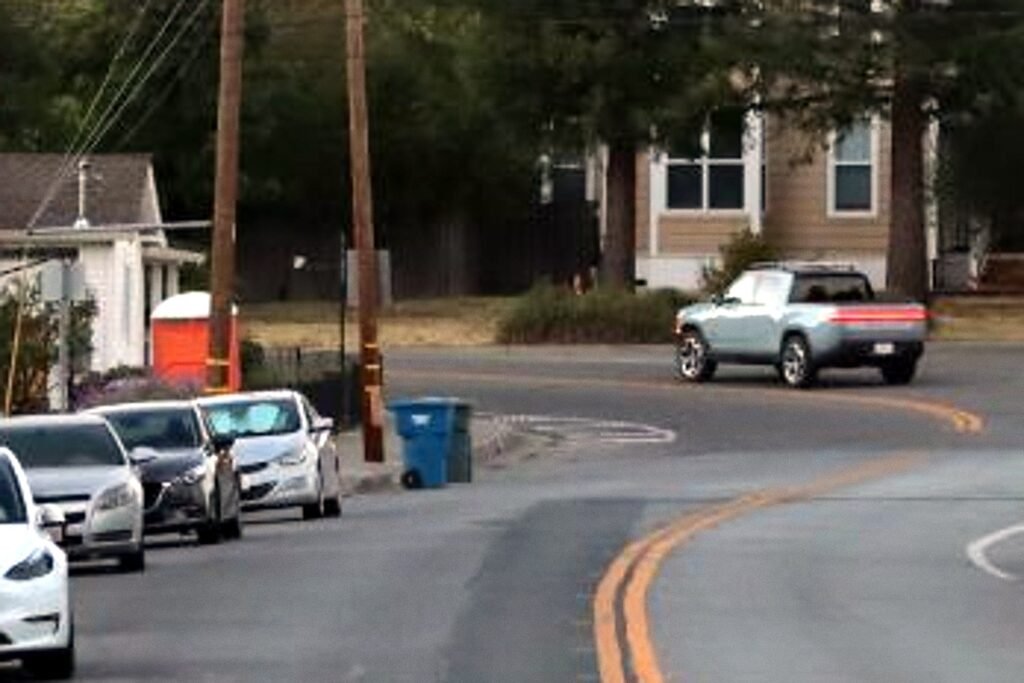
HEALDSBURG, CA — Owning a Rivian is no longer considered a meaningful indicator of status or wealth in Healdsburg, according to a study released Tuesday by the newly formed Institute for Wine Country Social Research.
Researchers said the finding reflects a broader shift in how residents communicate financial success in a town where $80,000 electric trucks have increasingly become difficult to distinguish from ordinary household expenses.
“Five years ago, a Rivian said something,” said Dr. Martin Bell, the study’s lead researcher. “It said you had money, cared about the environment, liked the outdoors, and were comfortable spending on a car what it would cost to buy a single family home in Detroit.”
“Now it mostly says you live in Healdsburg.”
The study surveyed 417 Healdsburg residents, employees, and real estate professionals and people who “had strong opinions about other people’s cars.”
Researchers found that Rivian ownership no longer generates significant social distinction among residents of the wine country community.
The reason, Bell said, is not that Rivians have become affordable.
“It’s actually the opposite,” he said. “The problem is that Healdsburg has become expensive enough that a Rivian is no longer an especially useful way to demonstrate that you have money.”
A Different Kind of Flex
According to the study, Healdsburg’s wealthiest residents have increasingly moved away from conspicuous displays of automotive wealth and toward subtler forms of winery-adjacent financial signaling.
“Anyone can finance a Rivian,” Bell said. “The more meaningful question is whether you can say you didn’t actually need to finance it at all.”
Researchers identified several behaviors currently carrying more social weight than Rivian ownership, including:
- Serving on a nonprofit board and describing it as “mostly just showing up”
- Having a second home and referring to it as “the place up in the mountains”
- Spending $14,000 on landscaping and calling it “just cleaning things up”
- Mentioning that you recently sold “a property downtown” without specifying which one
- Having opinions about which Healdsburg restaurant has “gotten too popular”
Perhaps the most significant emerging status symbol, researchers said, is the ability to spend substantial amounts of money while appearing mildly inconvenienced by doing so.
Old Money Changes the Equation
The study found that Healdsburg’s particular relationship with old, unbothered money has created an unusually high threshold for what qualifies as conspicuous consumption.
“A Rivian might impress someone in another town,” Bell said. “But in Healdsburg, people are accustomed to seeing someone spend $180 on lunch and then drive home to a guest house nobody’s allowed to see.”
Researchers said this has created a difficult environment for residents attempting to establish themselves near the upper end of the local socioeconomic hierarchy.
“You need something that says more than ‘I have $90,000 for a vehicle,’” Bell said. “You need something that says, ‘I have $90,000 for a vehicle and I don’t consider it noteworthy.’”
Among the most effective signals, according to the report, is owning a vehicle that is objectively worse than a Rivian and mentioning it as little as possible.
“A dusty old Tacoma can communicate tremendous wealth if the owner casually explains that they only really drive it ‘around the property,’” Bell said.
“Especially if they don’t appear to know how much it cost.”
Rivian Owners Defend Their Purchases
Several local Rivian owners interviewed for the study rejected the suggestion that they had purchased their vehicles as status symbols.
“I bought it because I care about the environment,” said one resident while standing beside an $92,000 R1S.
Another said the vehicle was primarily a practical choice.
“It fits everything,” she said, gesturing toward an otherwise empty rear cargo area.
A third owner said the Rivian was particularly useful for trips to the vineyard.
When asked which vineyard, he paused.
“It’s not technically ours,” he said.
He then clarified that his family “has an interest in it.”
Researchers said this distinction may represent an important emerging category of Healdsburg wealth signaling.
What Replaces the Rivian?
The Institute for Wine Country Social Research said it is still unclear which object will eventually replace the Rivian as Healdsburg’s preferred indicator of disposable income.
Early candidates include:
- A vintage Land Cruiser with new tires
- An extremely expensive bicycle
- A second, Plaza-adjacent property described as “a little place”
- A kitchen renovation described as “finally getting around to it”
One candidate has already pulled ahead of the field. SingleThread’s new ten-room property, Selvedge, opened this fall in a restored 1885 Victorian on the north end of town — the former home of Isabelle Simi Haigh, one of the first women winemakers in the country. Bell said the Institute has already logged a measurable shift in local signaling behavior.
“A Rivian in the driveway means you have money,” Bell said. “A Selvedge reservation means you have money and somewhere better to be. That’s a different category entirely.”
Bell added that the Institute is now separately tracking residents who mention being on the Selvedge waitlist, a group that considerably outnumbers residents who have actually stayed there.
Researchers also identified what they called the “anti-flex”: owning an obviously expensive property while insisting that it is “nothing special.”
“That’s becoming extremely powerful,” Bell said.
The Institute plans to release a follow-up study later this year examining whether owning chickens has also lost its status as a marker of rural authenticity.
“We’re seeing some troubling signs,” Bell said. “There are now too many chickens.”
For now, researchers said Healdsburg residents should not worry about the disappearance of the Rivian as a status symbol.
“There’s always another way to demonstrate that you have winery money,” Bell said.
“You just have to make sure it doesn’t look like you’re trying.”